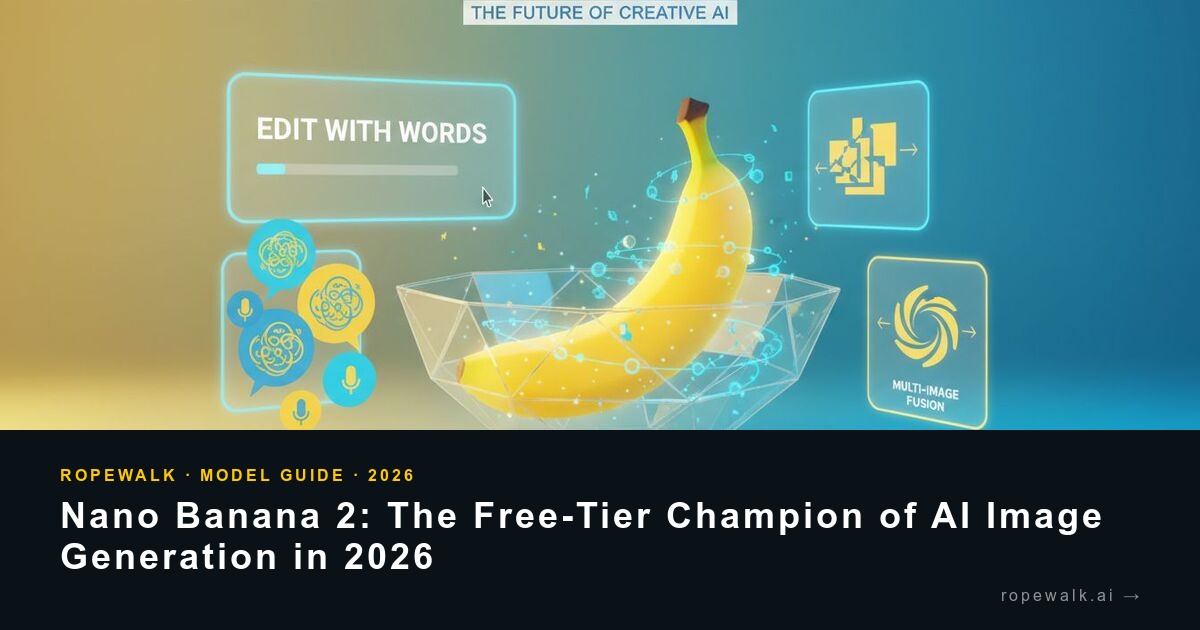
Nano Banana 2
Google's Nano Banana 2 is the 2026 free-tier champion for AI image generation — fast, conversational editing, multi-image fusion. Tested + benchmarked.
Nano Banana 2: The Free-Tier Champion of AI Image Generation in 2026
Google's Nano Banana 2 is the model most people will use as their default AI image generator in 2026 — not because it tops the photorealism leaderboards (that's Imagen 4 Ultra) or the LLM-Stats arena (that's GPT Image 2), but because it's the only flagship with a generous free tier, native conversational editing ("now make the jacket leather"), and multi-image fusion in one tool. Released by Google in late 2025 and improved through 2026, Nano Banana 2 sits at the intersection of "fast enough to iterate" and "good enough for production" — and on Ropewalk it's available the moment you sign in, no waitlist, no API key. This guide explains what Nano Banana 2 does differently, the three prompt patterns that hit hardest, and how to run it on Ropewalk in under a minute.
By Ropewalk Team. Tested on 2026-05-24 against the live Google Gemini Image backbone via the Ropewalk model catalog (176 live models).
The Quick Answer
Nano Banana 2 is Google's fast image-generation and editing model — text-to-image, image-to-image, multi-image fusion, and character consistency all in one. It's the 2026 free-tier champion: a generous allocation on Ropewalk gets you ~100+ generations before topping up, conversational editing handles "make the t-shirt navy" in plain English, and multi-image fusion lets you combine a logo + a product photo + a background plate in a single prompt. Trade-offs: less photoreal than Imagen 4 Ultra, less text-rendering-perfect than GPT Image 2. For everyday creative work where speed and free access matter more than peak quality, it's the right default. (148 words.)
Featured output
What's new in Nano Banana 2 vs Nano Banana 1
Nano Banana 1 (released Aug 2025) was already a strong fast image model, but it had three weaknesses that designers hit constantly: it couldn't fuse more than 2 reference images cleanly, character consistency drifted across follow-up generations, and conversational edits ("make it sunset") required full re-prompting instead of incremental adjustments. Nano Banana 2 fixes all three.
| Capability | Nano Banana 1 | Nano Banana 2 |
|---|---|---|
| Multi-image fusion | 2 images reliably | 3 images with logo / product / background semantics preserved |
| Character consistency across follow-ups | drifty after edit 2 | stable across 4–6 follow-up edits |
| Conversational editing | full re-prompt required | incremental ("now darker", "add fog") |
| Underlying model | Gemini 2.0 Flash Image | Gemini 3.1 Flash Image |
| Free-tier ceiling on Ropewalk | low | expanded (see live cost in model card) |
| Output resolution | 1K default | up to 2K on supported sizes |
The headline upgrade is the Gemini 3.1 Flash Image backbone. Where v1 was a fast-but-limited bolt-on, v2 was trained alongside Gemini 3.1 from scratch — which is why instruction-following and multi-image reasoning both improved at the same time.
Why Nano Banana 2 wins the 2026 free-tier crown
Three flagships claim "free tier" in 2026: Nano Banana 2, Imagen 4 Ultra (limited), and FLUX 2 Pro (preview). Nano Banana 2 wins for three structural reasons.
- Truly generous free allocation — Ropewalk's free signup credits cover the equivalent of ~100 Nano Banana 2 generations before requiring a topup. That's enough for a designer to test the model across multiple briefs before committing.
- Conversational editing — only Nano Banana 2 and Nano Banana Pro support genuine instruction-based follow-ups in the same session ("now make the t-shirt leather"). Other flagships require full re-prompting, which doubles cost.
- Multi-image fusion in one call — drop up to 3 reference images and one prompt; Nano Banana 2 keeps the perspective of the product, the brand colors of the logo, and the lighting of the background. FLUX 2 Pro supports 4 references but charges per generation. Nano Banana 2 absorbs the cost into the free tier.
How to use Nano Banana 2 on Ropewalk in 4 steps
The full path from sign-in to first generation is under 30 seconds. New accounts include free coins on signup — see pricing for plan details.
- Open Nano Banana 2 on Ropewalk or pick it from the model switcher in /chat.
- Type your text prompt — or, for an edit pass or fusion, drag 1–3 reference images onto the prompt area.
- Pick output size (square 1024×1024, portrait, landscape, or 2K for supported sizes).
- Hit Generate. Output arrives in 5–8 seconds for 1024×1024.
For follow-up edits, type the change in plain English ("now make it nighttime", "swap the navy for forest green") and hit Generate again — Nano Banana 2 holds the previous output as context.
Three prompt patterns that hit hardest
Pattern 1 — Illustration & storybook art
The fox prompt above is a worked example. Nano Banana 2 has strong illustration capabilities — gouache, watercolor, ink, vector flat — at speeds image-to-illustration apps can't match.
Pattern 2 — Product photography
Pattern 3 — Multi-image fusion (the killer feature)
Drop three reference images (logo + product + background plate) and use a fusion prompt:
When to choose Nano Banana 2 vs other 2026 flagships
| Job | Best model 2026 | Why |
|---|---|---|
| Free conversational editing | Nano Banana 2 | The only free-tier model with genuine follow-up edits |
| Readable text inside the image | GPT Image 2 | Paragraph-length text rendering |
| Maximum photorealism | Imagen 4 Ultra | Skin pores, fabric weave, hair strands |
| Brand design + SVG export | Recraft V4 Pro | Native SVG, brand-style training |
| Image-only instruction edits | Nano Banana Pro | Instruction-only variant, pixel-stable |
| 4-image reference fusion | FLUX 2 Pro | Up to 4 refs, paid per gen |
For a full head-to-head, see GPT Image 2 vs Nano Banana 2 vs Imagen 4 Ultra vs FLUX 2 Pro.
Pricing on Ropewalk
Nano Banana 2 uses Google's per-generation pricing with a free-tier allocation. The live model card above shows the current per-image cost in coins, and Ropewalk's free signup credits cover roughly 100+ generations. For volume work, top up via pricing.
Limitations to plan around
- In-image text — improved over v1 but not GPT Image 2 level. For posters, signage, packaging — use GPT Image 2.
- Maximum photorealism — Nano Banana 2 leans illustrative-photoreal. For editorial portrait fidelity, pair with Imagen 4 Ultra.
- Real faces of public figures — refused at the API level, like all OpenAI/Google image models.
- 2K cap on free tier — beyond 2K, top up to a paid plan.
Start generating with Nano Banana 2
Open the model page, upload up to 3 references (optional), type your prompt, hit Generate. First image arrives in 5–8 seconds.
Comments
Comments feature coming soon! Stay tuned.