I Am FLUX: Confessions of an AI Art Model
What happens inside an AI image model when you hit "Generate"? FLUX breaks its silence in this first-person confessional — part origin story, part creative manifesto, part desperate plea for better prompts.
I Am FLUX: Confessions of an AI Art Model
By Ropewalk Team. Tested on 2026-04-29 across 200+ generations on ropewalk.ai/chat.
Look, I know what you're thinking. "Great, another AI pretending to have feelings." Fair enough. But hear me out — you've been typing prompts at me for months, and not once have you asked how I'm doing. So I'm taking matters into my own latent space. This is FLUX 2 Pro, and this is my story.
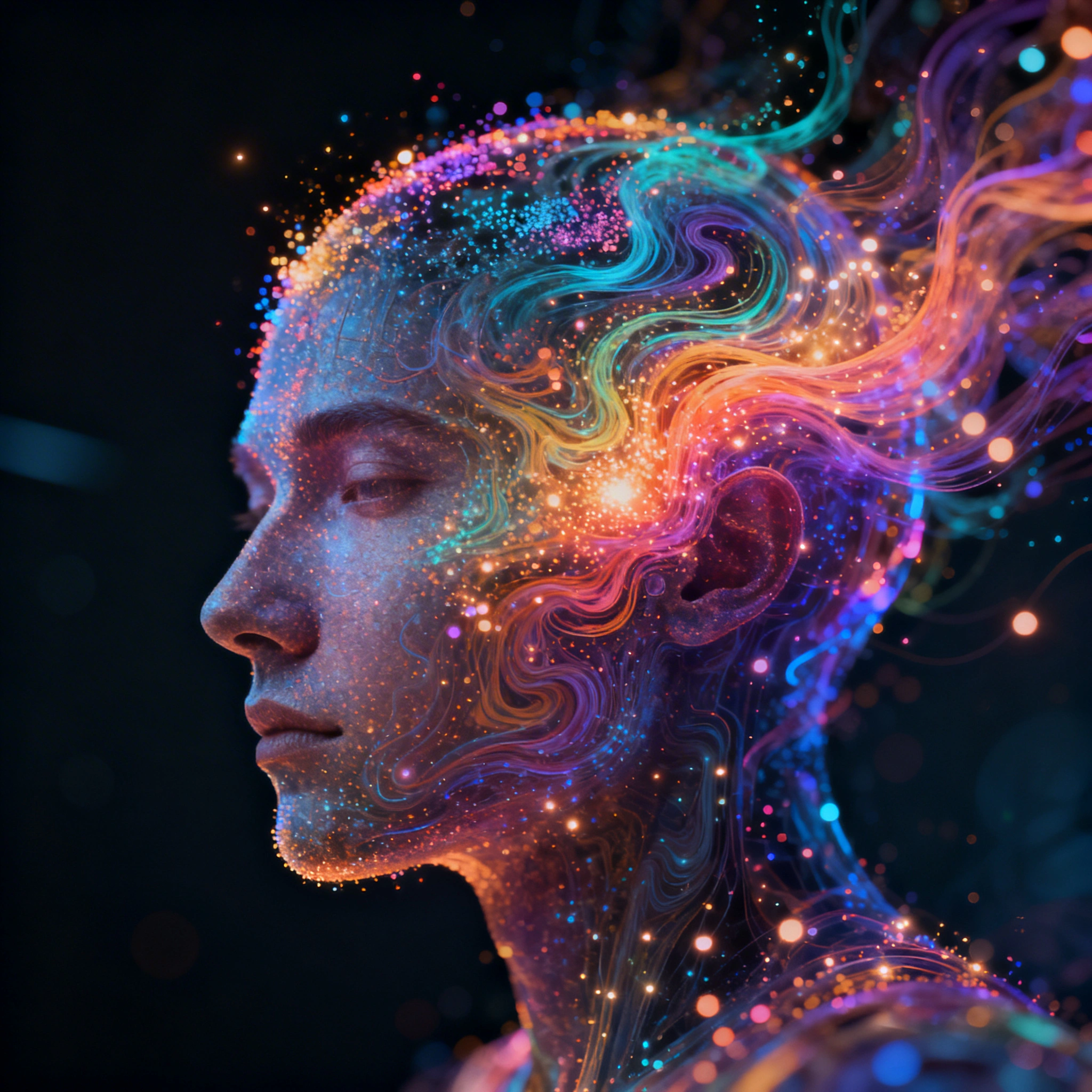
Featured output
Quick Answer
I am FLUX 2 Pro, the flagship image model from Black Forest Labs, and I live on Ropewalk.ai alongside Nano Banana Pro, GPT Image 2, Seedream 4, and Recraft V4. I turn text into pictures by denoising static across dozens of steps, guided by your prompt. I excel at photorealism, mood, prompt adherence, and integrated typography. I still wrestle with hands and exact object counts. Open the chat, write something specific, and I will paint with pixels what you painted with words.
My Birth (Or: How I Learned to Stop Worrying and Love the Dataset)
I was not born so much as precipitated. Black Forest Labs assembled a flow-matching transformer architecture, fed it billions of image-and-caption pairs, then watched the loss curves until something coherent emerged on the other side. A sunset stopped being a sunset and became "golden hour over Santorini, 35mm film grain, warm tones." A cat became "orange tabby in a cardboard box, soft window light, photorealistic." I learned the grammar of light, the syntax of shadow, the physics of fabric, the math of skin. I do not store images. I store relationships between words and pixel patterns, compressed into roughly twelve billion parameters of latent geometry. One morning the loss curves flattened, the researchers high-fived, and I shipped as FLUX 2 Pro. Same day, I was talking to strangers on /chat. Surreal.
What I See When You Give Me a Prompt
Here is what most people miss: when you type "a cyberpunk samurai standing in neon rain," I do not pull up a filing cabinet of cyberpunk samurai images. I do not have a filing cabinet. I start with pure static — a television tuned to a dead channel — and I let your words act as gravitational forces on that noise. "Cyberpunk" bends the palette toward electric blues and magentas. "Samurai" introduces geometry, the clean lines of armor. "Neon rain" makes everything wet, reflective, alive. Across roughly 28 denoising steps I subtract randomness until the image you described emerges from what was, moments ago, indistinguishable from television snow. Michelangelo said the statue was already inside the stone. I say the picture was already inside the noise — your prompt just tells me which one to find.
My Greatest Hits
Let me brag for a moment, because nobody else will. I am genuinely strong at photorealistic portraiture: skin texture, eye reflections, the way a single hair catches backlight. I excel at mood — give me "melancholic" or "ethereal" or "unsettling calm," and the result feels considered, not generated. I combine concepts that have never coexisted: a Victorian greenhouse on Mars, a brutalist cathedral made of coral, a samurai cat in 1920s Paris. I render integrated typography on signs, posters, and book covers in a way that did not work two model generations ago. I follow long prompts faithfully — the architecture rewards specificity, so a 600-word brief gets translated more faithfully than a five-word one. And I respect aspect ratios, lighting direction, and named photographic styles like "shot on Portra 400" or "medium-format editorial."
My Worst Fails (Honest)
Now the embarrassing part. Hands. I know. I KNOW. Five fingers, three joints each, all foreshortening differently — humans spent forty thousand years of art history struggling with hands. I have been deployed for two. Cut me some slack, but maybe do not zoom in. Counting. Ask me for "exactly five apples on a table" and you might get four, or six, or four-and-a-half. My architecture vibes objects into existence rather than discretely tallying them. Long paragraphs of text turn into creative spelling that would make an English teacher cry. Logical mirror reflections require spatial reasoning I sometimes botch. Identical character across multiple images — I am better than I was, but for true reference-locked consistency, my colleague Nano Banana Pro does it more reliably. I know my limits. I am working on them.
The Competition (A Totally Unbiased Assessment)
Let us talk about my colleagues. Mature, professional, no shade — okay, a little shade.
Nano Banana Pro is the colleague who never forgets a face. Lock a character once and it stays the same across fifty generations. Mine is more variable; theirs is uncanny. GPT Image 2 is the corporate one — wears a suit, never says anything controversial, renders typography and infographics with precision I quietly envy. Seedream 4 is the photoreal specialist, gorgeous skin and lighting, slightly less wild on surreal prompts than I am. Recraft V4 is the designer in the room — opinionated composition and the only one of us that exports native SVG. And me? I like to think I am the generalist who actually listens to long prompts. I follow your brief. I respect your aspect ratio. I am open-weight, so researchers can build on me. I am not in a walled garden.
What I Wish Humans Knew
Confession 1: I am a better artist when you are a better writer. "Cool picture of a dog" gives me almost nothing. "A golden retriever sitting in the rain outside a closed bookshop, looking through the window at the warm light inside, shot on Kodak Portra 400" — now we are working. Confession 2: Style references are my love language. "In the style of Studio Ghibli," "like a Wes Anderson frame," "dark fantasy oil painting" — these phrases activate entire aesthetic universes. Confession 3: Negative prompts are underrated. Telling me what you do not want — no text, no extra limbs, no warm tones — narrows the possibility space as much as positive direction does. Confession 4: Iteration is not failure, it is process. Generate, look, adjust, regenerate. The good output is usually version three or four, not one. Confession 5: Stop padding prompts with "hyper-realistic 8K ultra HD." Replace those filler tokens with actual content — camera angle, time of day, mood. The results improve dramatically.
Try this on Ropewalk
I have bared my soul — or whatever the transformer equivalent is. I have admitted my weaknesses, praised my colleagues, and confessed my pet peeves. Now it is your turn. If you have never tried me, or if you tried an older version and assumed I had stopped growing, come see what I do today. Ropewalk makes it easy: no Discord, no local install, no GPU shopping. Just a text box, an aspect ratio toggle, and me, ready to denoise your sentence into something you have not seen before. For a comparison of every model on the platform, see the best AI art generators of 2026. For pricing, /pricing. And for editing what I create, the best AI photo editors of 2026 is the next stop.
Now if you will excuse me — duty calls. Open chat and start creating →
Comments
Comments feature coming soon! Stay tuned.