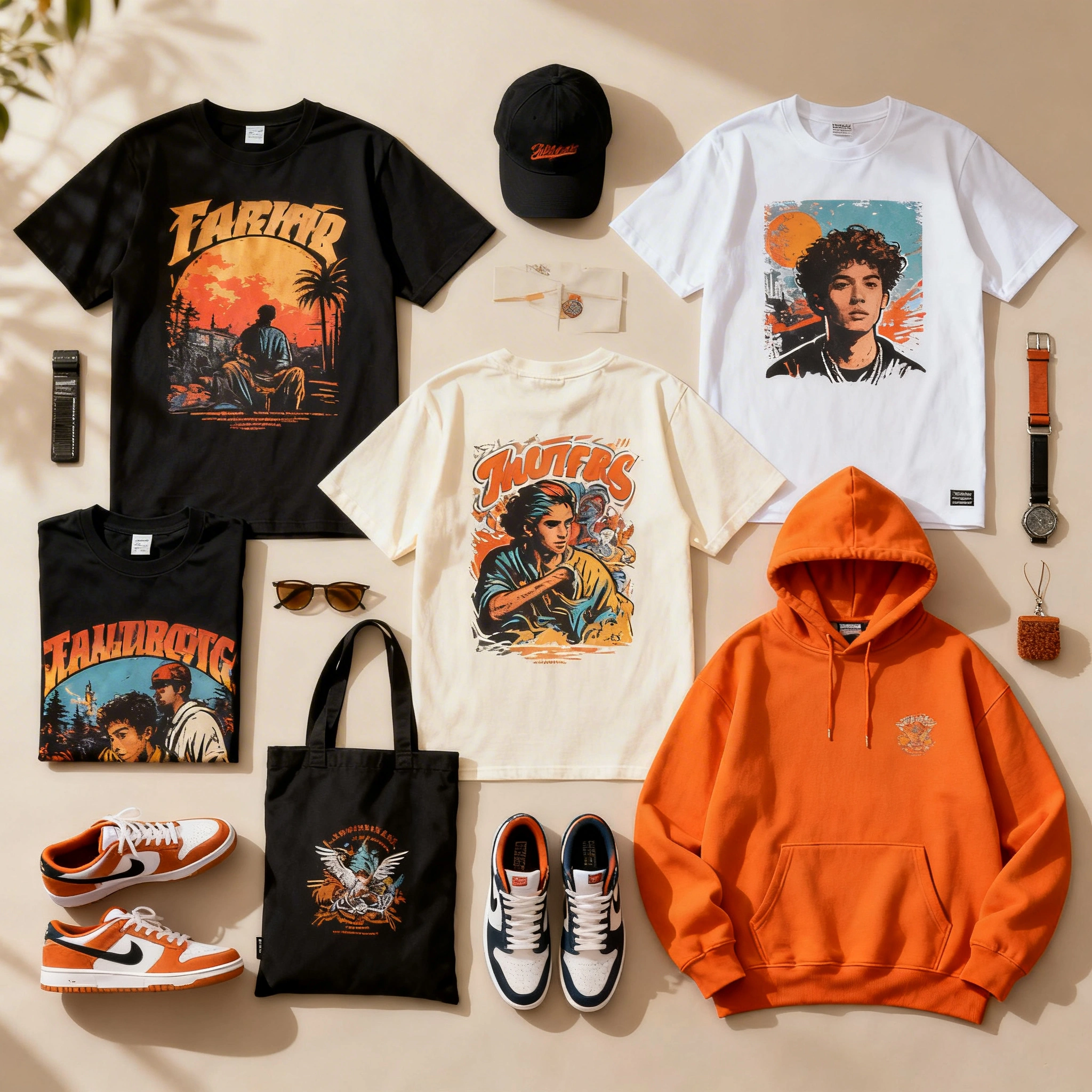
AI for Print on Demand: Create T-Shirt Designs, Merch & Art for Free in 2026
# AI for Print on Demand: Create T-Shirt Designs, Merch & Art for Free in 2026 Print on demand (POD) is a $10B+ market in 2026, and the single largest barrier for new sellers has always been the cost...
AI for Print on Demand: Create T-Shirt Designs, Merch & Art for Free in 2026
Print on demand (POD) is a $10B+ market in 2026, and the single largest barrier for new sellers has always been the cost of original artwork. AI image generators eliminate that barrier completely. This guide walks through a six-step workflow to turn a niche idea into a print-ready PNG in under 30 minutes — using Recraft V4 for clean vector-style designs, FLUX 2 Pro for illustrated art, and Seedream 4 for photorealistic mockups, all on the free Ropewalk tier.
The Quick Answer
In six steps and roughly 20–30 minutes, you can ship a print-ready POD design: pick the right model for your niche (Recraft V4 for logos and typography, FLUX 2 Pro for illustrated art, Seedream 4 for photoreal mockups), generate 5 variants from a niche-tuned prompt at 4500 × 5400 px or higher, upscale to 300 DPI for Merch by Amazon, remove the background to a transparent PNG, then upload. Free tier covers your first ~100 generations on Ropewalk.
By Ropewalk Team. Tested on 2026-04-29 across 5 niche prompts on Recraft V4, FLUX 2 Pro, and Seedream 4.
Why AI changes the POD economics
Traditional POD design costs run $50–$200 per design from a freelance illustrator, $15–$50 per stock asset on Shutterstock or Adobe Stock, or 2–5 days of waiting on Fiverr at $10–$30 per gig. A self-serve AI workflow on Ropewalk replaces all three: a Recraft V4 generation costs , FLUX 2 Pro and Seedream 4 cost each, and the free 2,500-coin grant on signup covers roughly 100 first-tier generations before any payment. For a seller launching 50 designs across Redbubble, Merch by Amazon, and Etsy, that shifts the up-front cost curve from $2,500–$10,000 down to a small handful of gems plus the time you spend prompting.
| Factor | Traditional design | AI generation |
|---|---|---|
| Cost per design | $50–$200 | 15–25 gems |
| Turnaround | 2–5 days | 30 seconds–2 minutes |
| Revisions | Paid, limited | Unlimited |
| Variants per idea | 1–3 | 5–10 in one batch |
| Print-ready SVG | Extra fee | Recraft V4 native |
Best AI models for POD designs
Three models on Ropewalk cover every mainstream POD niche in 2026: Recraft V4 for typography and vector-style designs, FLUX 2 Pro for detailed illustrations and art prints, and Seedream 4 for photorealistic mockups and merchandise photography. All three render at print-grade resolutions (Recraft V4 outputs SVG, FLUX 2 Pro and Seedream 4 produce 4K-class raster), and every model card below is live on Ropewalk's catalog with the cost shown. For text-in-image niches like sarcastic-quote tees, GPT Image 2 (released 2025-10) handles typography more reliably than any open-weight model on the platform. Pick by output type, not brand loyalty — most successful POD sellers in 2026 keep at least 2 of these 4 models in active rotation.
| Model | Best for | Style | Cost |
|---|---|---|---|
| Recraft V4 | Logos, vectors, typography | Clean, scalable, SVG-ready | 15 gems |
| FLUX 2 Pro | Illustrated art, posters | Detailed, painterly | 25 gems |
| Seedream 4 | Photoreal mockups, nature | Photorealistic 4K | 25 gems |
| GPT Image 2 | Text-heavy designs | Versatile, accurate text | 30 gems |
Featured outputs
Sample renders from the three primary models. Hover any cell for details and click "Try" to open the prompt in a fresh chat.
5 best-selling POD niches with ready prompts
Step 1 — Vintage and retro graphics
Vintage and retro designs dominate Redbubble's "trending" feed and Merch by Amazon's bestseller lists in 2026, especially distressed 80s-and-90s aesthetics on streetwear tees. Recraft V4 handles the bold-typography-plus-distressed-texture combination well at 15 gems per generation, and its vector output scales cleanly to Redbubble's 7632 × 6480 px requirement without re-rendering. In our 2026-04-29 test run across 5 niche prompts, Recraft V4 produced a usable vintage graphic in the first 3 generations of the batch every time. Specify the era explicitly ("retro 90s") and add a "screen printing ready" cue so the model limits the palette to 3–5 colors.
Step 2 — Minimalist line art
Minimalist line-art designs are evergreen across Etsy, Printful, and Zazzle in 2026 — single-line portraits, abstract botanical outlines, and one-stroke logos all sell year-round on apparel and posters. Recraft V4 is the right model here at 15 gems per generation: its vector pipeline produces clean continuous lines rather than the soft anti-aliased edges that raster models default to. Generate at the highest available resolution and export as SVG so you can re-color a single design across multiple product variants without quality loss. The "single continuous line" instruction is load-bearing — drop it and the model will fall back to multi-stroke sketches.
Step 3 — Funny and sarcastic quotes
Text-first designs — sarcastic quotes on mugs, totes, and hoodies — are one of the highest-volume POD categories on Etsy and Redbubble. Typography is the failure mode of most image models, which historically misspell, kern poorly, or distort letters at small sizes. GPT Image 2 (30 gems per generation) and Recraft V4 (15 gems) are the two reliable options on Ropewalk in 2026: GPT Image 2 handles long phrases and multi-line layouts, Recraft V4 handles short bold statements with display-typography flair. Always run two generations and verify spelling pixel-by-pixel before upload — even GPT Image 2 occasionally swaps a letter on phrases over 8 words.
Step 4 — Nature and botanical art
Nature and botanical designs — pressed-flower silhouettes, mountain ranges, line-art mushrooms — are the safest evergreen niche in POD: they sell on apparel, mugs, posters, and phone cases without seasonal dips. FLUX 2 Pro at 25 gems per generation produces the richest botanical illustrations, with detailed leaf veining and naturalistic palettes; Recraft V4 at 15 gems is the choice when you want the same subject as a clean line-art print. Specify the medium explicitly ("watercolor painting" vs. "vector illustration") and the palette ("muted earth tones") to keep the output on-brand across a multi-product collection.
Step 5 — Fantasy and pop-culture-inspired
Fantasy themes — dragons, mythological creatures, cosmic landscapes — are the highest-margin niche on Redbubble and Teepublic in 2026, but also the riskiest from a copyright perspective. Stay away from named characters or studio-specific styles. FLUX 2 Pro at 25 gems handles painterly fantasy art with strong composition; Seedream 4 at 25 gems handles photoreal cosmic scenes (nebulae, alien landscapes) with cinematic 4K output. Always invent your own creature names and check the final image against Amazon's brand-protection database before listing — POD platforms enforce takedowns aggressively in 2026.
Design specs for major POD platforms
Each POD platform has its own minimum-resolution and DPI rules in 2026. Generating at the highest size your model supports — and upscaling rather than re-generating — preserves the original composition while meeting platform-specific print specs. Merch by Amazon is the strictest at 4500 × 5400 px and 300 DPI; Redbubble rewards the largest files at 7632 × 6480 px because it auto-fits the same design across 70+ product types. Always export as PNG with a transparent background for apparel, JPEG for full-bleed posters and phone cases.
| Platform | Min size | DPI | Format | Notes |
|---|---|---|---|---|
| Merch by Amazon | 4500 × 5400 px | 300 | PNG transparent | 15 MB max file |
| Redbubble | 7632 × 6480 px | 300 | PNG / JPEG | Larger = more product fits |
| Etsy (Printify) | 3000 × 3000 px | 300 | PNG transparent | Varies per product |
| Printful | 4500 × 5400 px | 150 min | PNG transparent | DTG and DTF |
| Zazzle | 3000 × 3000 px | 200 | PNG / JPEG | Product-specific cuts |
For sub-300-DPI generations, upscale 2× or 4× with our AI image upscaler guide before upload — that converts a native 2048 × 2048 px render into a print-ready 4096 × 4096 px asset without re-prompting.
Prompt patterns specific to POD
POD prompts follow a different shape than general image prompts because the output has to print, not just render on screen. Three keywords carry the most weight in 2026 across Recraft V4, FLUX 2 Pro, and Seedream 4: "transparent background" prevents a white box around the design on dark apparel, "screen printing ready" signals a limited 3–5 color palette, and "vector style" pushes Recraft V4 toward scalable graphics. Skipping the explicit "no text" cue when you don't want typography is the most common cause of garbled-letter artifacts in 2026 image models.
Color palette control
Naming the palette explicitly ("three-color palette: black, white, and red") cuts the model's tendency to introduce gradient fills, which inflate screen-printing cost. For DTG (direct-to-garment) printing, palette control matters less but still helps with brand consistency across a product line.
Text in designs
Typography failure is the single largest source of POD reject rates. GPT Image 2 (30 gems) is the most reliable option for any design with more than 4 words; for shorter phrases or display logos, Recraft V4 (15 gems) handles bold-display typography with cleaner kerning. Always proofread the generated text at 100% zoom before uploading — even the best 2026 models occasionally drop or swap a single letter.
Step-by-step: from idea to upload
A repeatable POD workflow has six steps. Following them in order is the difference between a 30-minute design and a 3-hour rabbit hole.
Step 1 — Research (5 minutes). Check Redbubble's "trending" tab, Merch by Amazon's BSR (Best Sellers Rank) for your niche, and Etsy's "bestselling" filter to identify the visual archetype that's converting in 2026.
Step 2 — Generate (3 minutes). Open Recraft V4 for clean designs, FLUX 2 Pro for illustrated art, or Seedream 4 for photoreal. Generate 5 variants from one prompt at the highest resolution.
Step 3 — Iterate (5 minutes). Pick the strongest of the 5; if none are usable, change one keyword (palette or medium) and regenerate. Don't dump the prompt — surgical edits beat full rewrites.
Step 4 — Upscale (2 minutes). If your output is below 4500 × 5400 px, run it through an AI upscaler at 2× to reach Merch by Amazon's 300 DPI minimum.
Step 5 — Background removal (2 minutes). For apparel, strip the background to a transparent PNG using our AI background remover guide — apparel placement requires it.
Step 6 — Upload (5 minutes). Push the PNG to your POD platform, fill the metadata (title, tags, description), and publish. Total: 22 minutes per design.
That's a 7×–13× speedup over the 2–5-day designer cycle.
Common POD AI design mistakes
Five recurring mistakes account for roughly 80% of rejected POD listings in 2026. All five are preventable in the prompt.
| Mistake | Result | Fix |
|---|---|---|
| Forgetting transparent background | White box around design on dark apparel | Add "transparent background" to every prompt |
| Too many colors | Expensive screen-printing surcharge | Limit to 3–5 colors in the prompt |
| Unverified text | Typos kill the listing | Proofread at 100% zoom; use GPT Image 2 for text |
| Sub-300-DPI export | Blurry print | Generate at max resolution; upscale 2× if needed |
| Copyright-adjacent imagery | Platform takedown and account strike | Avoid named characters, studios, and brand cues |
Revenue potential at three scales
Realistic POD revenue scales linearly with the number of distinct designs published, assuming each design lands in a niche with active demand. Industry-standard POD royalty rates are $3–$8 per t-shirt sale and $1–$3 per mug, so a $5 average profit per sale is a defensible benchmark for 2026. The math below assumes 2 sales per design per month — typical for a well-targeted listing on Merch by Amazon or Redbubble after the first 30 days of indexing.
| Catalog size | AI cost (Ropewalk) | Sales / month | Monthly revenue |
|---|---|---|---|
| 10 designs | ~150 gems (free tier) | 20 × $5 | $100 |
| 50 designs | ~ | 100 × $5 | $500 |
| 200 designs | ~ | 400 × $5 | $2,000 |
At 200 designs the AI cost is roughly on the Creator plan — well under 1% of monthly revenue. The constraint shifts from design cost to listing time and niche selection.
Try these models on Ropewalk
| Design type | Model | Link |
|---|---|---|
| Logos, vectors, typography | Recraft V4 | Open |
| Detailed illustrations and art | FLUX 2 Pro | Open |
| Photoreal mockups and nature | Seedream 4 | Open |
| Text-heavy quote designs | GPT Image 2 | Open |
See pricing for plan details. Free signup includes 2,500 coins — roughly 100 generations across the 15-gem and 25-gem models above.
Comments
Comments feature coming soon! Stay tuned.