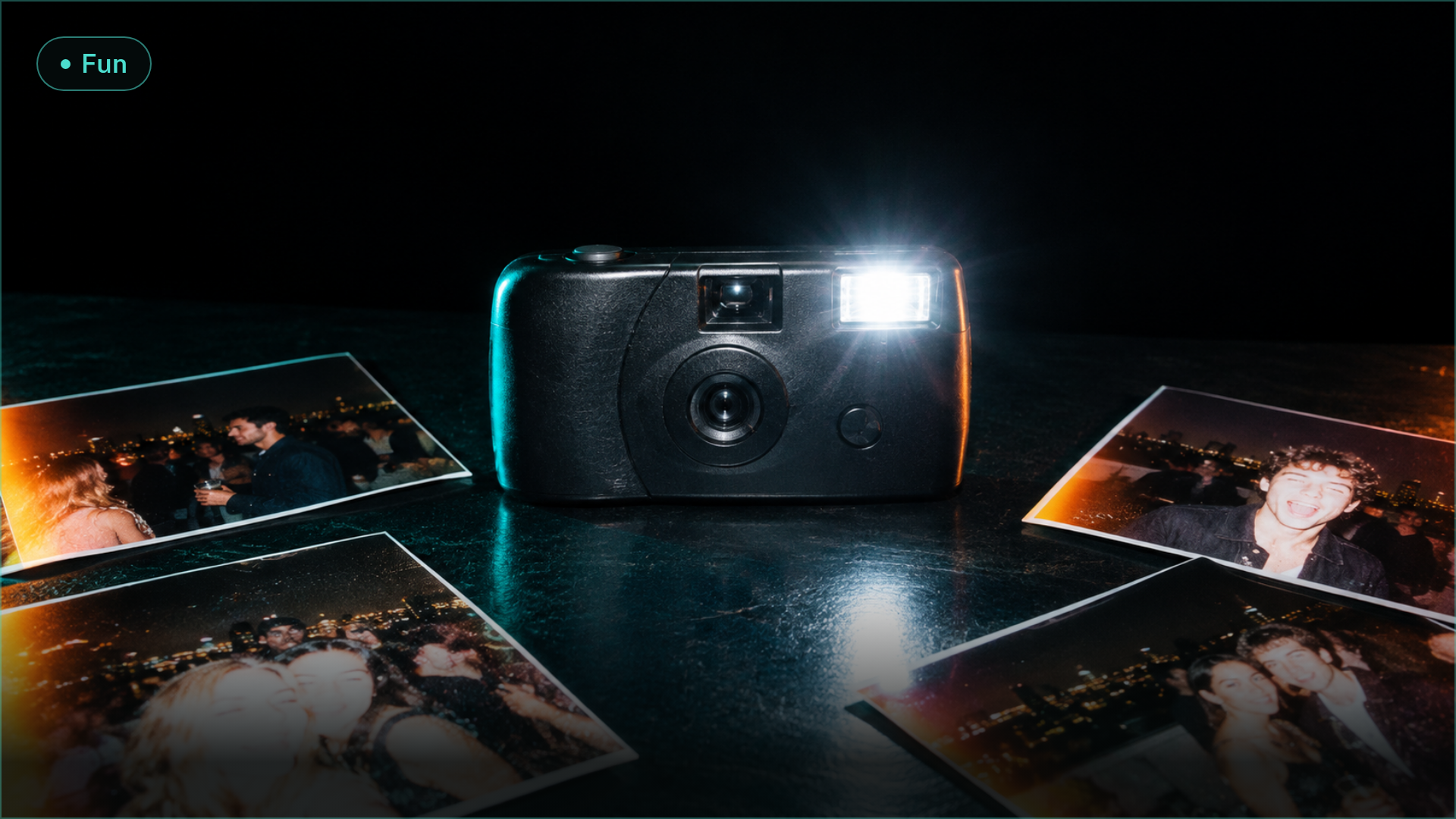
Disposable Camera Look: 3 AI Models Fake One Roll (2026)
Fujifilm's QuickSnap turned 40 in July 2026. We gave FLUX 3 Image, GPT Image 2.5 Flare and Ideogram 4.5 one flash-and-grain prompt to see who fakes a disposable-camera roll best.
Disposable Camera Look: 3 AI Models Fake One Roll (2026)
Fujifilm marked 40 years of the QuickSnap disposable camera in July 2026, and the grainy, flash-blasted look it made famous is back in every feed. We gave FLUX 3 Image, GPT Image 2.5 Flare and Ideogram 4.5 the same 80-word prompt to see which one can fake a frame from a 27-exposure roll. The brief was simple: one rooftop party, three models, no re-rolls, and a verdict based only on what each model actually returned on 2026-10-13.
By Ropewalk AI Team. Tested on 2026-10-13 across 3 generations, one per model, same prompt, default settings.
The Quick Answer
GPT Image 2.5 Flare gave the most convincing disposable-camera frame: hard flash, red-eye, a crooked crop and a blurred hand at the edge. Ideogram 4.5 won on night atmosphere, and FLUX 3 Image looked more like an instant print than a throwaway camera.
Why the disposable look is back in 2026
Disposable-camera aesthetics are rising again in 2026, and the appeal is the opposite of what AI usually sells: nothing is clean. A single-use camera has a fixed plastic lens, a weak built-in flash, no preview screen and a roll of 27 frames you cannot retake. Every flaw is a feature: blown-out foreground faces, black backgrounds, orange light leaks, a finger in the corner.
That makes it a great stress test for image models, which are trained to fix exactly those flaws. We covered the same instinct in our 2007 digicam flash test and the 80s portrait showdown. This time the target is the one-use plastic camera on a party table.
The experiment: one prompt, three models
The prompt formula has four ingredients: a candid scene, a flash behaviour (blown-out faces, murky background), film damage (grain, faded colour, light leak) and bad framing (off-centre, thumb blur). We kept the scene fixed, a rooftop birthday at night, and ran it exactly once per model on 2026-10-13 with default settings and no re-rolls. The prompt is 80 words long, names no brand, person or character, and asks for the same three friends, lanterns and lemonade in every run, so any difference in the output comes from the model, not the brief.
Each model is public on Ropewalk, and the cards below show its live price per generation.
Results: the same party, three cameras
All three images below come from the exact prompt shown, on the exact model named, first try, with default settings. Generation times were 45.6 seconds for FLUX 3 Image, 12.2 seconds for GPT Image 2.5 Flare and 9.7 seconds for Ideogram 4.5, and the output sizes differ too: 1248×832, 1536×1024 and 1024×1024 pixels. We judged each frame on three questions: does the flash blow out the foreground, does the background fall to black, and does the framing look accidental. Each frame below is shown at its native aspect ratio, and the prompt is repeated word for word, so you can verify that nothing changed between runs.
FLUX 3 Image: a tidy instant print
FLUX 3 Image returned a 1248×832 frame with a white instant-film border and a vertical rainbow-orange light leak on the left. The faces are evenly and pleasantly lit, which is the opposite of what a disposable flash does, and the framing is tidy, with all three friends centred and sharp. The skyline stays readable instead of dropping into black. The result reads as a nice Polaroid, not a 27-exposure throwaway, and it took the longest of the three at 45.6 seconds.
GPT Image 2.5 Flare: the roll that came back from the lab
GPT Image 2.5 Flare delivered a 1536×1024 frame that follows the formula almost line by line. Faces are shiny and flash-lit with red-eye, the skyline sinks into near-black, a hot orange leak burns down the left edge, the cup tilts out of frame and a blurred hand cuts into the right side. Grain is coarse and the crop is slightly crooked, exactly the way a real roll looks. At 12.2 seconds it was also the second fastest. Nothing in the frame looks tidied up, which is why it passes for a lab scan at a glance.
Ideogram 4.5: the moody night shot
Ideogram 4.5 produced a 1024×1024 square with a wide-angle, slightly fisheye feel, glowing paper lanterns and a blurred hand in the foreground. The flash falloff is convincing, with the rooftop fading into black and a thin orange streak on the left. It ignored "three friends" and put four people in the frame, and it added red sunglasses and a cake nobody asked for, so the faces are less blown out than the brief. It was the fastest of the three at 9.7 seconds.
Which model won, and why
GPT Image 2.5 Flare wins this round on the three things that define a disposable camera: harsh flash on the subjects, a dark falloff behind them and imperfect framing. We judged one generation per model on 2026-10-13, so treat this as a sharp first impression, not a benchmark. The table below scores the three frames on those criteria, plus generation time and live price per image, so you can weigh authenticity against speed and cost. Ties were broken in favour of the frame that looked least like a deliberate photograph.
| Model | Flash falloff | Grain and leak | Bad framing | Time | Cost |
|---|---|---|---|---|---|
| FLUX 3 Image | Weak, evenly lit | Mild grain, rainbow leak | Tidy, instant-print border | 45.6 s | |
| GPT Image 2.5 Flare | Strong, red-eye | Coarse grain, hot leak | Crooked, hand in frame | 12.2 s | |
| Ideogram 4.5 | Strong, moody | Light grain, thin leak | Fisheye, blurred hand | 9.7 s |
GPT Image 2.5 Flare was also the cheapest of the three at 55 coins per image, against 100 for FLUX 3 Image and 120 for Ideogram 4.5. If you want atmosphere over authenticity, Ideogram 4.5 is the pick, and FLUX 3 Image suits clean instant-print looks. Because the authenticity win came from a single run, re-roll two or three times before you commit a whole batch to one model, since flash and leak placement vary from frame to frame. That advice costs only a few more generations and saves a lot of guessing.
Try it yourself: the prompt template
Swap the scene and keep the four ingredients: a candid moment, a flash that blows out the foreground, film damage and sloppy framing. The prompt below is a new scene we have not run, so it is a starting point, not a showcase. Paste it into GPT Image 2.5 Flare, the model that matched the look best in our test, then run the same text on the other two models to compare your own roll. Change one ingredient at a time, such as the leak colour or the thumb position, to learn what each model listens to. Five or six variations of the scene are usually enough to find a version you like. Our whole test, 3 generations, took about 68 seconds of generation time.
Want more nostalgia tests? Our 2007 digicam flash trend post covers the compact-camera flash look, and Ropewalk lets you run your own 27-frame experiment across all three models tested here. A full imaginary roll is 27 generations, so start with five frames, pick your favourite model and only then scale up. That keeps a first experiment small, quick and easy to compare side by side. Pick any three scenes from your own phone roll as the first test set. Keep every prompt in one note so the three outputs stay comparable.
Comments
Comments feature coming soon! Stay tuned.