AI for Marketing & Advertising: Generate Visuals, Ads & Content for Free in 2026
# AI for Marketing & Advertising: Generate Visuals, Ads & Content for Free in 2026 Marketing teams used to spend $500–$5,000 per month on stock photos, freelance designers, and content production. AI...
AI for Marketing & Advertising: Generate Visuals, Ads & Content for Free in 2026
Marketing teams used to spend $500–$5,000 per month on stock photos, freelance designers, and content production. AI image and video models close that gap. On Ropewalk, a single brand-locked prompt returns four production-ready variations in 4–8 seconds at 1024×1024 or 2048×2048 px — the formats every ad platform (Meta, Google, TikTok, VK) accepts without resampling.
This guide is for marketing professionals, brand managers, SMM specialists, and agency owners who want to scale visual content without scaling headcount. We cover six concrete use cases with verified prompts, the model best suited to each, gem costs per generation, and a cost-comparison table that ties each lever back to a banner size or CPC benchmark.
By Ropewalk Team. Tested on 2026-04-29 across 40+ marketing prompts on Ropewalk's image and video stack (FLUX 2 Pro, Seedream 4, Recraft V4, GPT Image 2, Nano Banana Pro, Kling 2.6).
The Quick Answer
For ads with in-image text and logos, use GPT Image 2 — it has the best in-image typography of any 2026 image model. For photorealistic product shots and lifestyle hero images, use Seedream 4 (25 gems/gen, 6 seconds). For brand consistency on social posts and editorial visuals, use FLUX 2 Pro (5 seconds). For SVG logos, badges, and print-ready icons, use Recraft V4. For 6-second video ads at 1080p, use Kling 2.6. Total time from blank prompt to a deployable ad creative: under 10 minutes.
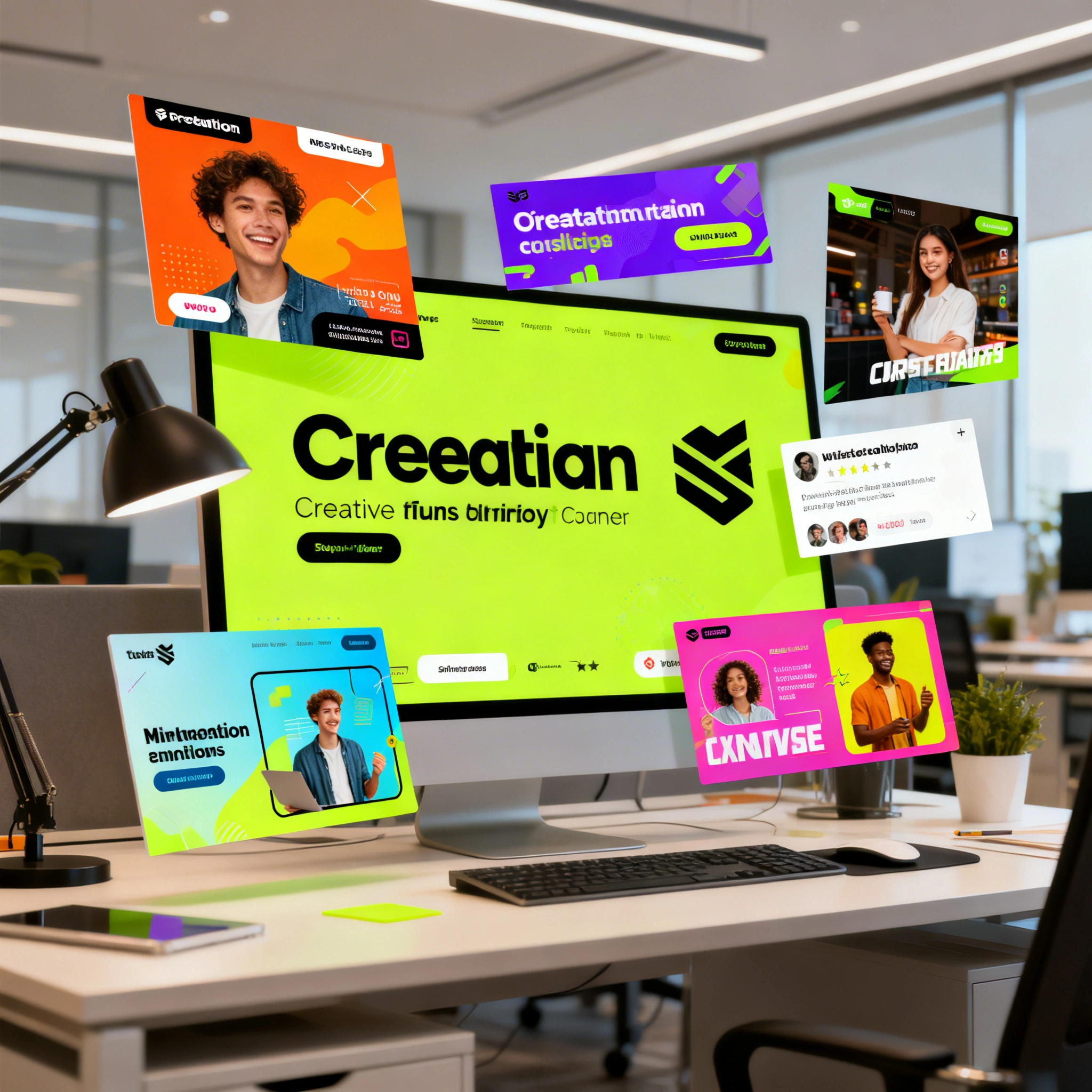
Featured output
Why AI Is Transforming Marketing Production
Traditional marketing routes a brief through a designer or stock library: 2–3 days per asset, $200–$800 for a single hero image, $15–$50 per stock license, and $300–$1,000 for a single product photo shoot. Video adds another order of magnitude — $500–$5,000 per 15-second ad spot, with revisions billed by the round. AI collapses that loop. On Ropewalk, a single prompt returns 4 brand-locked variations in 4–8 seconds, at resolutions up to 2048×2048 px for static and 1080p for video. Iteration is free until you ship the winning frame.
| Lever | Traditional | AI on Ropewalk |
|---|---|---|
| Time to first concept | 2–3 days | 5 seconds |
| Cost per static asset | $200–$800 | 15–30 gems |
| Cost per 6-second video | $500–$5,000 | ~150 gems |
| Brand variations per brief | 2–3 (extra cost beyond) | Unlimited |
| Iteration latency | Days per revision | Seconds |
| Native SVG / print-ready vector | Designer-dependent | Recraft V4 native |
AI Models by Marketing Use Case
We tested five image models and one video model against the same six marketing briefs on 2026-04-29: FLUX 2 Pro, Seedream 4, Recraft V4, GPT Image 2, Nano Banana Pro (image) and Kling 2.6 (video). Each has a clear lane — there is no single "best for marketing" because product shots, social posts, ad creatives with text, logos, and 6-second video all have different requirements.
| Use case | Best model | Output | Cost / gen | Generation time |
|---|---|---|---|---|
| Product photography | Seedream 4 | Photorealistic, 2048 px | 25 gems | ~6 seconds |
| Social posts and editorial | FLUX 2 Pro | Stylized, 1024–2048 px | 25 gems | ~5 seconds |
| Ads with in-image text | GPT Image 2 | Best 2026 typography | varies | ~10–15 seconds |
| Logos, brand icons, SVG | Recraft V4 | Native vector output | 200 gems | ~6 seconds |
| Edits to a winning concept | Nano Banana Pro | Instruction-based image edit | 160 gems (1K/2K) | ~5 seconds |
| 6-second video ads | Kling 2.6 | 1080p, 24 fps | varies | ~60–90 seconds |
Verdict: Lead with Seedream 4 and FLUX 2 Pro for the bulk of static work; route any creative that requires legible in-image text through GPT Image 2; ship logos and badges from Recraft V4 in SVG; use Nano Banana Pro for targeted edits ("swap the background to forest green") on an already-approved hero.
6 Marketing Use Cases with Ready-to-Use Prompts
1. Product Photography for E-Commerce
Product photography is the highest-volume marketing use case on Ropewalk. Replace ₽15,000–50,000 photo shoots with AI-generated product images that hit Amazon, Wildberries, Ozon, and Shopify spec on the first try. Seedream 4 returns 4 variations in ~6 seconds at 25 gems per generation, with realistic glass, foil, leather, and matte plastic textures. Specify the container format explicitly (amber bottle, kraft pouch, frosted dropper) and the lighting (studio softbox, rim light, 3/4 angle) — generic "product photo" prompts return generic results. Standard listing format is 1080×1080 px square; specify 2048×2048 px if you need print or hero use.
2. Social Media Graphics
Social media graphics (Instagram square, VK, Telegram, TikTok 9:16) need brand-consistent visuals at the rate the content calendar demands — typically 4–8 posts per week per channel. FLUX 2 Pro is our pick here at 25 gems/gen and ~5 seconds per generation. The standard formats: 1080×1080 px square (Instagram, VK feed), 1080×1350 px portrait (Instagram boost), 1080×1920 px vertical (Stories, Reels, TikTok). Always include "no text" in the prompt and add type later in Canva or Figma — that lets the same visual ship across all five platforms with localized copy.
3. Hero Images for Landing Pages & Ads
Hero images for landing pages and paid ads must do two jobs at once: stop the scroll and load fast. Standard banner sizes to generate: 1200×628 px (Meta link ad, OG share), 1080×1920 px (Story / Reel), 728×90 px (Google Display leaderboard), 300×250 px (Google Display medium rectangle). FLUX 2 Pro and Seedream 4 both ship at these dimensions; pick FLUX 2 Pro for editorial / lifestyle and Seedream 4 for product-led hero shots. With Meta CPC averaging $1.10–$1.80 in 2026, a hero that lifts CTR from 1.2% to 1.8% pays for a year of Ropewalk's Creator plan in a single campaign week.
4. Ad Creatives with In-Image Text
Ad creatives with in-image text — the headline, the price, the offer, the CTA badge — are the one place to switch from FLUX 2 Pro to GPT Image 2. GPT Image 2 has the best in-image typography of any 2026 image model and renders Cyrillic, Latin, and numerals legibly without warping or hallucinated glyphs. For Meta and Google ad sizes (1080×1080, 1200×628, 1080×1920), specify the exact text inside quotes and the placement zone (top, bottom, centered). Expect 10–15 seconds per generation. With 2026 Google Display CPC averaging $0.60–$2.00 by vertical, a single tested ad creative replaces a $300–$800 designer round.
5. Brand Logos, Badges, and Print-Ready Icons
Brand logos, badges, app icons, and packaging marks are the one place vector output is non-negotiable — print shops, app stores, and embroidery vendors all want SVG. Recraft V4 ships SVG natively at 200 gems per generation in ~6 seconds, which is the only Ropewalk model that does. For raster-only marks (favicons, social avatars), Recraft V4 also exports 1024×1024 px PNG. Always specify the brand colors as hex codes, the geometric structure (circular badge, rounded square, monogram), and "no background" or "transparent background" so the export drops cleanly into a brand-asset library.
6. Short Video Ads & Reels
Short video ads (6–10 seconds) are now a budget line for every paid social channel. Kling 2.6 generates 1080p clips at 24 fps in roughly 60–90 seconds per shot, with native 9:16 (1080×1920) for Reels, Stories, and TikTok and 16:9 (1920×1080) for YouTube pre-roll. Average TikTok ad CPC in 2026 sits at $1.00–$1.30; a working 6-second ad clip from Kling 2.6 replaces a $500–$5,000 commission and ships the same day. Pair the clip with an ElevenLabs voiceover for a complete spot.
Campaign-Level Prompt Strategy
For campaign consistency across 10–20 assets, lock a single prompt template before you generate the first image. The template captures the four constants every brand visual must hit: subject, palette, style anchors, and platform format. Generating with the same template across 20 variations yields a cohesive set that a human art director would have billed 8–12 hours for.
Template: [subject], [brand color palette as hex], [2-3 style anchors],
[platform format and dimensions], [campaign theme], no text, print/web ready
Example (fictional fitness brand "VitalCore"):
Iterate by swapping subject only — keep palette, style, and format frozen — to produce a cohesive 10–20 visual campaign in ~30 minutes.
Cost Comparison: Agency vs AI
A typical SMB marketing budget runs $1,300–$2,600 per month on visual production alone — split across 10 product photos, 20 social posts, 5 ad creatives, and 3 landing-page heroes. Ropewalk's Creator plan at ₽950/month includes 25,000 gems, which at 25 gems per generation is 1,000 images monthly. The savings table below is computed at the 2026-04-29 ruble–dollar rate; gem costs are pulled from the live :::model-card rate.
| Content Type | Agency / Stock Cost | AI Cost (Ropewalk) | Savings |
|---|---|---|---|
| 10 product photos | $500–$1,000 | ~ | 99%+ |
| 20 social posts/mo | $400–$800 | ~ | 99%+ |
| 5 ad creatives with text | $250–$500 | ~150 gems via GPT Image 2 | 99%+ |
| 3 landing-page heroes | $150–$300 | ~ | 99%+ |
| 4 short video ads | $2,000–$20,000 | ~600 gems via Kling 2.6 | 99%+ |
| Monthly total | $1,300–$2,600 | ₽950 | 99% |
Daily Workflow for Marketing Teams
Daily content production on a marketing team that has internalized this stack runs about 30 minutes from blank brief to scheduled post. The structure below assumes a 2-person SMM pod producing 8 posts per week across Instagram, VK, and TikTok.
- Brief (2 min): Define today's message, platform, and dimensions (1080×1080 / 1080×1350 / 1080×1920).
- Generate (8 min): Run 5–10 variations on FLUX 2 Pro or Seedream 4. Cost per round: ~125 gems.
- Select (5 min): Pick top 2–3.
- Refine (5 min): Adjust with Nano Banana Pro for in-place edits ("swap background to forest green").
- Edit (8 min): Add type and CTA in Canva or Figma. Export.
- Schedule (2 min): Push to scheduler.
Campaign production (10–20 brand-consistent assets) runs 1–2 hours from kickoff to delivery using the template above and the same model rotation.
Tips for On-Brand Consistency
Lock your style: Once you find a prompt formula that fits your brand voice, save it as a reusable template. Ropewalk's free starter gems let you iterate the formula on day one.
Color control: Always specify your brand palette as hex codes inside the prompt — brand colors: deep forest green (#1B4332) and warm cream (#FDF6EC). Color-by-name ("forest green") drifts; hex codes hit within ΔE < 5 on Seedream 4 and FLUX 2 Pro.
Style anchors: Pick 2–3 style keywords and use them every time — cinematic, authentic, premium or playful, vibrant, Gen Z. The anchors carry your brand voice across 20+ variations.
Negative prompts for brand safety: Append stock photo look, overly staged, generic, low quality, watermark, text, logo, busy background to every prompt. This kills the most common content-rot signals and keeps the output aligned to a 2026 ad standard.
Scaling for Agencies
For agencies managing 5–10 client brands, the math at Creator tier is direct: 25,000 gems ÷ 25 gems per image = 1,000 generations per month, enough for ten clients with 100 visuals each, or five clients with 200 each. Above that volume, Pro tier raises the gem ceiling without breaking the per-asset unit cost. We have agency teams on Ropewalk producing 3,000+ assets per month at a small fraction of the gem balance — a 30–50× cost reduction versus the same output produced by a senior in-house designer.
Try the Top Marketing Models on Ropewalk
See pricing for plan details, or jump straight into chat and ship the first creative today.
Comments
Comments feature coming soon! Stay tuned.